







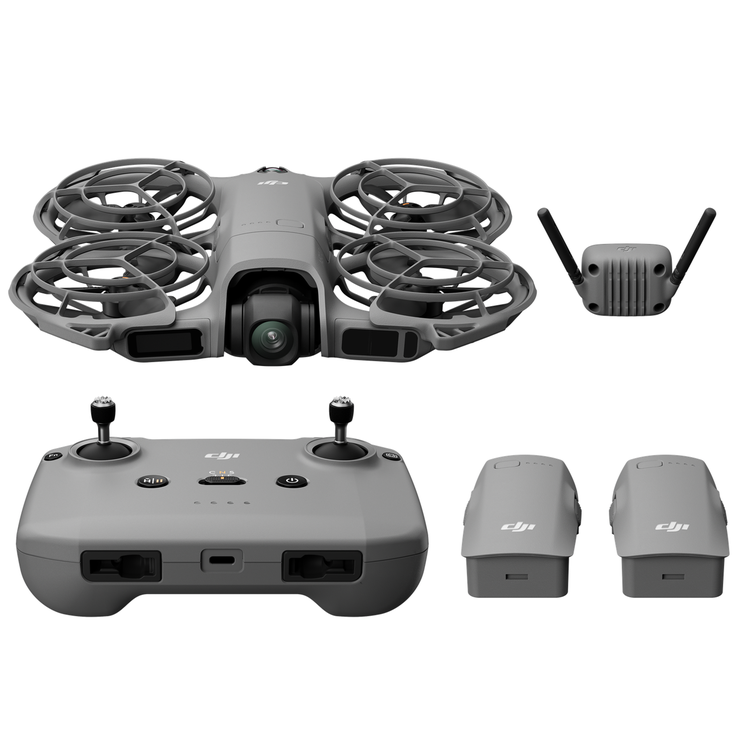
DJI Neo 2 is DJI's most compact drone [1] equipped with omnidirectional obstacle sensing [2] and features such as gesture control [3], SelfieShot, and ActiveTrack [4] for more creative ways to fly. Even beginners can get started effortlessly. Think of it as your personal follow-me camera drone, always ready to capture your most exciting moments. - Palm Takeoff &; Landing [5], Gesture Control [3]- Faster, Smoother Tracking With ActiveTrack [4]- Easy Moment Capture With SelfieShot- Omnidirectional Obstacle Sensing [2] and Versatile Flight [6]- 4K High-Quality Imaging [7]- Lightweight, Portable Design With Full-Coverage Propeller Guards Master Flight With Ease DJI Neo 2 features an onboard display for intuitive shooting mode selection. To launch, point it at yourself and press the takeoff button with one hand to take off directly from your palm [5], then perform automatic camera movements. The new Return-to-Palm feature [3] allows Neo 2 to precisely locate your palm, return safely, and land steadily, making flights easier than ever. More Ways to Control, More Fun Neo 2 can follow you effortlessly even without a remote controller, ensuring every exciting moment is captured. Pair it with DJI RC-N3 or RC 2 remote controller for easy-to-start aerial flights. Put on DJI goggles and use the motion controller for immersive FPV flights [8]. The fun never stops! Gesture Control Easily adjust Neo 2's direction and proximity with one or both hands [3]. Point your palm toward the drone to guide it up, down, or side to side, or use both palms for precise control over proximity. No remote controller is needed for camera angle adjustment. Voice Control via Mobile Neo 2 supports voice control [9][10], so you can send flying commands using your smartphone or Bluetooth earphones [11] with complete freedom, whether on a run or cycling. When connected to your phone, it can capture audio and intelligently reduce noise, automatically filtering out propeller noise. This feature enables you to record content independently on your own. Mobile App Control Control Neo 2 with virtual joysticks on the DJI Fly app interface and quickly delve into the joy of flying with no need for a separate purchase of a remote controller. RC Control When paired with DJI RC-N3 remote controller, Neo 2 can achieve a maximum video transmission distance of 10 km [13]. Flexibly operate the camera using traditional RC control sticks when you need to capture professional-level shots. Motion Control When paired with the motion controller and goggles, Neo 2 supports motion control, Easy ACRO, offering an immersive FPV experience. Easy Moment Capture With SelfieShot Capture solo or group moments hands-free with SelfieShot, which lets you effortlessly switch between waist-up, full-body, and long shots without a tripod or any extra assistance. Whether it's birthday parties, weekend picnics, or family outings, Neo 2 automatically composes every scene and maneuvers the camera as needed to capture your cherished moments with just a tap. Dual Protection for Safe Flight Omnidirectional obstacle sensing [2] and full-coverage propeller guards deliver dual protection for worry-free flights. Capture life's moments effortlessly while enjoying the freedom of flight. Internal Storage 49GB internal storage supports long 4K video recording [7], allowing uninterrupted content capture. Power Replenishment Connect the drone directly to a power source using a USB-C data cable for convenient charging. Neo 2's Two-Way Charging Hub can charge three batteries simultaneously [17], increasing both charging speed and efficiency. QuickTransfer With file transfer speeds up to 80 MB/s [18], stunning footage is available instantly. Return to Home (RTH) Don't worry about returning home; when using palm takeoff or mobile app control, Neo 2 will return to the home point after completing its course. When using a remote controller or immersive motion control, Neo 2 supports Return to Home (RTH) and Failsafe RTH, activating obstacle avoidance during the return for enhanced safety and beginner-friendly operation. 19-Min Flight Time [19] With up to 19 minutes of flight time [19], Neo 2 can perform over 20 excursions [20] to and from your palm in succession, documenting life's little moments with its sleek design and reliable flight duration. Wind Resistance Hover stably in winds up to 10.7 m/s for dependable outdoor capture. [4] Versatile Sets, Your Way With multiple combo options, DJI Neo 2 adapts to your creative style and shooting demands. From effortless everyday tracking shots, to beginner-friendly aerial capture and fully immersive flight experiences, you'll always find the ideal match.
- Takeoff Weight
- 151 g (without DJI Neo 2 Digital Transceiver)
- 160 g (with DJI Neo 2 Digital Transceiver)
- The actual product weight may vary due to differences in batch materials and external factors.
- Dimensions
- 147×171×41 mm (L×W×H, with propeller guards and without DJI Neo 2 Digital Transceiver)
- 167×171×54 mm (L×W×H, with propeller guards and DJI Neo 2 Digital Transceiver)
- Max Ascent Speed
- 0.5 m/s (Cine mode)
- 3 m/s (Normal mode)
- 5 m/s (Sport Mode)
- Maximum speed measured in an open, windless environment, with the drone taking off from an altitude of 0 m and controlled via remote controller. Data are for reference only.
- Max Descent Speed
- 0.5 m/s (Cine Mode)
- 3 m/s (Normal Mode)
- 3 m/s (Sport Mode)
- Maximum speed measured in an open, windless environment, with the drone taking off from an altitude of 0 m and controlled via remote controller. Data are for reference only.
- Max Horizontal Speed
- 8 m/s (Normal Mode)
- 12 m/s (Sport Mode)
- 12 m/s (tracking status)
- Maximum speed measured in an open, windless environment, with the drone taking off from an altitude of 0 m and controlled via remote controller. Data are for reference only.
- Max Takeoff Altitude
- 2000 m
- Measured in a windless environment when taking off from an altitude of 2000 m and ascending vertically by 120 m, using Sport mode, and from 100% battery level until 20%. Data is for reference only. Always pay attention to reminders on the camera view during your flight.
- Max Flight Time
- Approx. 19 minutes (approx. 17 minutes with the propeller guards)*
- Each battery allows the drone to perform at least 20 palm takeoff and landing for shoots in succession**
- * Measured when flying forward at a speed of 4 m/s in a windless environment 20 m above sea level, without DJI Neo 2 Digital Transceiver, with camera parameters set to 1080p/30fps, video mode off, and from 100% battery level until 0%. Results may vary depending on the environment, actual use, and firmware version.
- ** Measured after DJI Neo 2 is activated, with a fully charged battery and default settings, and using Circle, Rocket, and Dronie modes, and is for reference only.
- Max Hovering Time
- Approx. 18 minutes (16.5 minutes with the propeller guards)
- Measured when hovering in a windless environment 20 m above sea level, without DJI Neo 2 Digital Transceiver, with camera parameters set to 1080p/30fps, video mode off, and from 100% battery level until 0%. Results may vary depending on the environment, actual use, and firmware version.
- Max Flight Distance
- 7 km
- Measured when flying forward at a speed of 9 m/s in a windless environment 20 m above sea level, without DJI Neo 2 Digital Transceiver, with camera parameters set to 1080p/30fps, video mode off, and from 100% battery level until 0%. Results may vary depending on the environment, actual use, and firmware version.
- Max Wind Speed Resistance
- 10.7 m/s (Level 5)
- Operating Temperature
- -10° to 40° C (14° to 104° F)
- Global Navigation Satellite System
- GPS + Galileo + BeiDou
- Hovering Accuracy Range
- Vertical:
- ±0.1 m (with vision positioning)
- ±0.5 m (with satellite positioning)
- Horizontal:
- ±0.3 m (with vision positioning)
- ±1.5 m (with satellite positioning)
- Internal Storage
- 49 GB
- Class
- C0 (EU)
- Image Sensor
- 1/2-inch CMOS Sensor
- Lens
- FOV: 119.8°
- Format Equivalent: 16.5 mm
- Aperture: f/2.2
- Focus: 0.7 m to 8
- ISO Range
- Photo
- 100-3200 (Single Auto)
- 100-12800 (Burst Auto/Timed Auto)
- 100-12800 (Manual)
- Video
- 100-12800 (Auto)
- 100-12800 (Manual)
- Shutter Speed
- Video: 1/8000-1/30 s
- Photo: 1/8000-1/10 s
- Max Image Size
- 12 MP Photo
- 4000×3000 (4:3)
- 4000×2250 (16:9)
- Still Photography Modes
- Single/Timed Shot
- Single Shot: 12 MP
- Timed Shot: 12 MP, 2/3/5/7/10/15/20/30/60 s
- Photo Format
- JPEG
- Video Resolution
- Horizontal Shooting:
- 4K (4:3): 3840×2880@60/50/30fps
- 1080p (4:3): 1440×1080@60/50/30fps
- 4K (16:9): 3840×2160@100*/60/50/30fps
- 1080p (16:9): 1920×1080@100*/60/50/30fps
- Vertical Shooting:
- 2.7K (9:16): 1512×2688@60/50/30fps
- * 4K/100fps and 1080p/100fps recording are only supported when using motion control or remote control.
- Video Format
- MP4
- Max Video Bitrate
- 80 Mbps
- Supported File System
- exFAT
- Color Mode
- Normal
- EIS
- Supports RockSteady and turning stabilization off.*
- * The stabilization switch (On/Off) is only available when paired with goggles. When stabilization is turned off, footage captured supports offline stabilization with Gyroflow.
- Stabilization
- 2-axis mechanical gimbal (tilt, roll)
- Mechanical Range
- Tilt: -125° to 105°
- Roll: -43° to 43°
- Controllable Range
- Tilt: -90° to 70°
- Max Control Speed (tilt)
- 100°/s
- Angular Vibration Range
- ±0.01°
- Image Roll Correction
- Supports correction of footage recorded on the drone
- Live view correction is unavailable only when using with goggles
- Sensing Type
- Omnidirectional monocular vision system, paired with a downward infrared sensing system and forward-facing LiDAR
- Forward
- Measurement Range: 0.5-10 m
- Detection Range: 0.5-15 m
- Effective Sensing Speed: Flight Speed = 8 m/s
- Backward
- Detection Range: 0.5-15 m
- Effective Sensing Speed: Flight Speed = 8 m/s
- Lateral
- Detection Range: 0.5-15 m
- Effective Sensing Speed: Flight Speed = 8 m/s
- Upward
- Detection Range: 0.5-15 m
- Effective Sensing Speed: Flight Speed = 3 m/s
- Downward
- Detection Range: 0.5-15 m
- Effective Sensing Speed: Flight Speed = 3 m/s
- Infrared Sensor
- Forward-Facing LiDAR:
- Measurement Range: 0.3-8 m (reflectivity > 10%)
- FOV: Horizontal 60°, Vertical 60°
- Downward-Facing Infrared Sensor:
- Measurement Range: 0.3-8 m (reflectivity > 10%)
- Operating Environment
- Forward, Backward, Left, Right, and Upward:
- Surfaces with discernible patterns and adequate lighting (lux > 5)
- Downward:
- Surfaces with discernible patterns and adequate lighting (lux > 5), and surfaces that are diffusely reflective with a reflectivity above 20% (e.g., walls, trees, people).
- Video Transmission System
- Standard: Wi-Fi Video Transmission
- Optional: DJI Neo 2 Digital Transceiver (O4)
- Live View Quality
- With DJI RC-N3 Remote Controller: Up to 1080p/60fps
- With DJI Goggles N3 plus DJI RC Motion 3/DJI FPV Remote Controller 3: Up to 1080p/60fps
- With DJI Goggles 3 plus DJI RC Motion 3/DJI FPV Remote Controller 3: Up to 1080p/100fps
- Operating Frequency
- 2.400 GHz to 2.4835 GHz
- 5.170 GHz to 5.250 GHz
- 5.725 GHz to 5.850 GHz
- Operating frequency allowed varies among countries and regions. Refer to local laws and regulations for more information.
- Transmitter Power (EIRP)
- 2.4 GHz:
- < 26 dBm (FCC)
- < 20 dBm (CE/SRRC/MIC)
- 5.1 GHz:
- < 23 dBm (CE)
- 5.8 GHz:
- < 26 dBm (FCC)
- < 14 dBm (CE)
- < 26 dBm (SRRC)
- Communication Bandwidth
- Max 60 MHz
- Max Transmission Distance (unobstructed, free of interference)
- FCC: 10 km
- CE: 6 km
- SRRC: 6 km
- MIC: 6 km
- Measured in an unobstructed outdoor environment free of interference using the remote controller or goggles and showed the farthest communication range for one-way, non-return flights under each standard. The maximum video transmission distance in the actual flight scenarios is limited by the drone's maximum flight distance. Always pay attention to RTH reminders on the live view during your flight.
- Max Transmission Distance (unobstructed, with interference)
- Strong Interference: Urban landscape, approx. 1.5-3 km
- Medium Interference: Suburban landscape, approx. 3-6 km
- Low Interference: Suburb/Seaside, approx. 6-10 km
- Measured under FCC standard in unobstructed environments with typical interference, using the remote controller or goggles. Used for reference purposes only and provides no guarantee for actual transmission distance.
- Max Transmission Distance (obstructed, with interference)
- Low Interference and Obstructed by Buildings: Approx. 0-0.5 km
- Low Interference and Obstructed by Trees: Approx. 0.5-3 km
- Measured under FCC standard in obstructed environments with typical low interference, using the remote controller or goggles. Used for reference purposes only and provides no guarantee for actual transmission distance.
- Max Download Speed
- Wi-Fi: 80 MB/s
- Measured in a laboratory environment with little interference in countries/regions that support both 2.4 GHz and 5.8 GHz. Download speeds may vary depending on the actual conditions.
- Lowest Latency
- With DJI RC-N3 Remote Controller or DJI RC 2 Remote Controller: Approx. 120 ms
- With DJI Goggles N3 (1080p/60fps Video Transmission): Lowest latency at 54 ms
- With DJI Goggles 3 (1080p/100fps Video Transmission): Lowest latency at 50 ms
- Latency data refers to the minimum delay during goggles screen refresh, measured in an open, interference-free environment. Actual performance may vary with shooting conditions and mobile device.
- Max Video Bitrate
- 60 Mbps
- Antenna
- 2 antennas, 1T2R
- Wi-Fi Protocol
- 802.11a/b/g/n/ac/ax
- Wi-Fi Operating Frequency
- 2.400 GHz to 2.4835 GHz
- 5.725 GHz to 5.850 GHz
- Operating frequency allowed varies among countries and regions. Refer to local laws and regulations for more information.
- Wi-Fi Transmitter Power (EIRP)
- 2.4 GHz:
- < 20 dBm (FCC/CE/SRRC/MIC)
- 5.8 GHz:
- < 26 dBm (FCC/SRRC)
- < 14 dBm (CE)
- Effective Operating Range
- 500 m
- Measured in an open outdoor environment free of interference. Actual video transmission distance may vary depending on the operating environment and mobile device performance. Refer to the actual experience.
- Bluetooth Protocol
- Bluetooth 5.2
- Bluetooth Operating Frequency
- 2.400 GHz to 2.4835 GHz
- Operating frequency allowed varies among countries and regions. Refer to local laws and regulations for more information.
- Bluetooth Transmitter Power (EIRP)
- < 10 dBm
- Battery Capacity
- 1606 mAh
- Battery Weight
- 46 g
- Nominal Voltage
- 7.16 V
- Max Charging Voltage
- 8.6 V
- Battery Type
- Li-ion
- Chemical System
- LiNiMnCoO2
- Energy
- 11.5 Wh
- Charging Temperature
- 5° to 40° C (41° to 104° F)
- Charging Time
- When Using the Two-Way Charging Hub (65W max charging power): Approx. 68 minutes to charge three batteries simultaneously from 0% to 100%
- When Directly Charging the Aircraft Body (15W max charging power): Approx. 70 minutes to charge from 0% to 100%
- Charging time is measured in a test environment with a temperature of 25° C (77° F). Actual charging time may increase due to higher ambient temperatures or variations in mains voltage between regions.
- Recommended Charger
- DJI 65W Portable Charger
- USB Power Delivery chargers
- Battery Charging Hub Input
- 5 V, max 5 A
- 9 V, max 5 A
- 12 V, max 5 A
- 15 V, max 4.33 A
- 20 V, max 3.25 A
- Max current depends on adapter capability.
- Battery Charging Hub Output (charging)
- 5 V, 2 A
- Battery Charging Hub Charging Method
- 3 batteries charged simultaneously
- The number of batteries that can be charged simultaneously depends on the power of the charger used. Using a charger rated above 45 W allows you to charge three batteries at the same time. Using a charger rated between 30 W and 45 W allows you to charge only two batteries simultaneously. Using a charger below 30 W will charge the batteries sequentially, from the highest remaining charge to the lowest. Refer to the charging protocols supported by the charger.
- Battery Charging Hub Compatibility
- DJI Neo 2 Intelligent Flight Battery
- Recommended microSD Cards
- Does not support storage expansion with an external SD card
- RC-N3 Remote Controller Max Operating Time
- Without charging any mobile device: 3.5 hours
- When charging a mobile device: 1.5 hours
- RC-N3 Operating Temperature
- -10° to 40° C (14° to 104° F)
- RC-N3 Charging Temperature
- 5° to 40° C (41° to 104° F)
- RC-N3 Charging Time
- 2 hours
- RC-N3 Charging Method
- 5 V, 2 A
- RC-N3 Battery Capacity
- 2600 mAh
- RC-N3 Weight
- Approx. 320 g
- RC-N3 Dimensions
- 104.2×150×45.2 mm (L×W×H)
- RC-N3 Operating Frequency
- 2.400 GHz to 2.4835 GHz
- 5.170 GHz to 5.250 GHz
- 5.725 GHz to 5.850 GHz
- Operating frequency allowed varies among countries and regions. Refer to local laws and regulations for more information.
- RC-N3 Transmitter Power (EIRP)
- 2.4 GHz:
- < 33 dBm (FCC)
- < 20 dBm (CE/SRRC/MIC)
- 5.1 GHz:
- < 23 dBm (CE)
- 5.8 GHz:
- < 33 dBm (FCC)
- < 14 dBm (CE)
- < 30 dBm (SRRC)
As an international traveller you are entitled to bring a certain amount/value of goods that are free of Customs duty and exempt Goods and Services tax (GST) into New Zealand. This is called your duty free allowance and personal goods concession. It is important to review these for any purchases you make on The Mall.
Your duty free allowance entitles you to bring into New Zealand the following quantities of alcohol products free of customs duty and GST provided you are over 17 years of age. You do need to be 18 years or over to purchase.
- Up to six bottles (4.5 litres) of wine, champagne, port or sherry or
- Up to twelve cans (4.5 litres) of beer
- And three bottles (or other containers) each containing not more than 1125ml of spirits, liqueur, or other spirituous beverages
Goods other than alcohol and tobacco, whether purchased overseas or purchased duty free in New Zealand, that have a combined total value not exceeding NZ$700 may also be brought as part of your personal goods concession.
When travelling overseas there are legal limits on the amount of duty free alcohol and other goods you can take with you. These amounts will vary depending on the country you are flying into. We always recommend you check the latest limits and exemptions.
Your order can be picked up at an Auckland Airport Collection Point. There is one in departures and one at arrivals in the international terminal. Alternatively, if you are arriving between 11pm and 6am you will be able to collect your order from our lockers. See map
Please bring your order confirmation email and your passport. If you are collecting from lockers you will have been sent an email with your access code, be sure to have this on you in order to collect your order.
If you’re departing Auckland Airport, we recommend that you come to the Auckland Airport Collection Point at least 60 minutes before your flight. If you miss your pickup time or your flight details have changed please let us know as soon as possible.
When you collect your order you will have the opportunity to inspect the items and sign for them.
If you need to return an item, our Collection Point team are there to help you. If you are collecting after hours please return the item to your locker and our team will be in touch as soon as possible. You may also like to view our Returns & refunds which provides information on how this works and outlines the individual retailer's returns and refunds policies.
After Hours Collections
If your order needs to be collected after the Auckland Airport Collection Point desk is closed, your order will be placed in the lockers next to the desk. All the details you will need to collect your order will be provided in your Order Confirmation and Ready to Collect Email.